


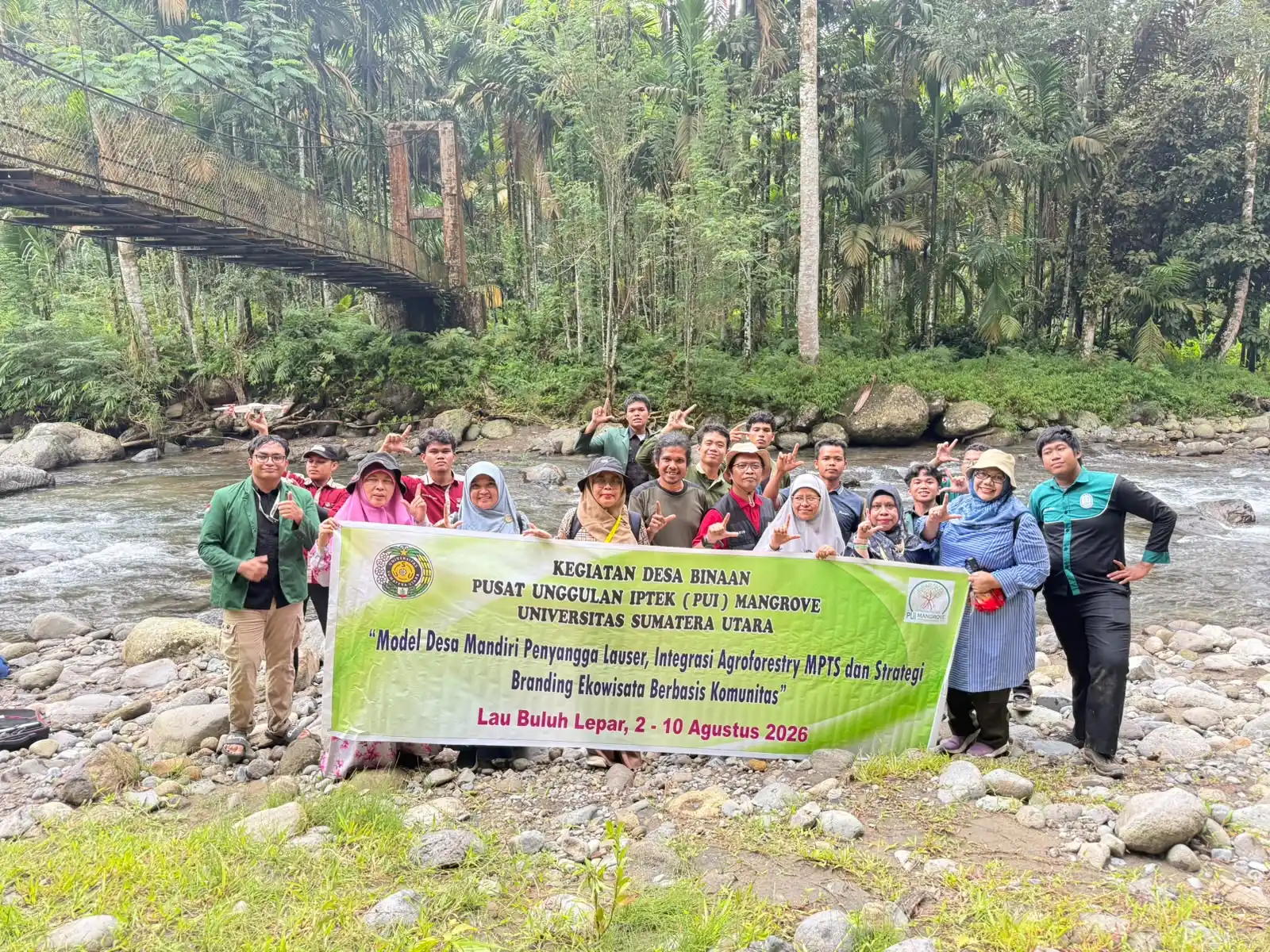
HUMAS FAHUTA – Universitas Sumatera Utara (USU) continues to strengthen its contribution to sustainable development through the development of villages based on local potential. Through the Community Development Program of the Faculty of Forestry and the Faculty of Mathematics and Natural Sciences (FMIPA), USU officially launched an Ecotourism Village in Lau Buluh Lepar Hamlet, Telagah Village, Sei Bingai District, Langkat Regency, North Sumatra, on Monday (August 10, 2026).
The program represents a strategic step by USU to support Lau Buluh Lepar in developing into a self-reliant village in the Leuser buffer zone by integrating community economic development, natural resource conservation, agroforestry, food security, and community-based ecotourism.
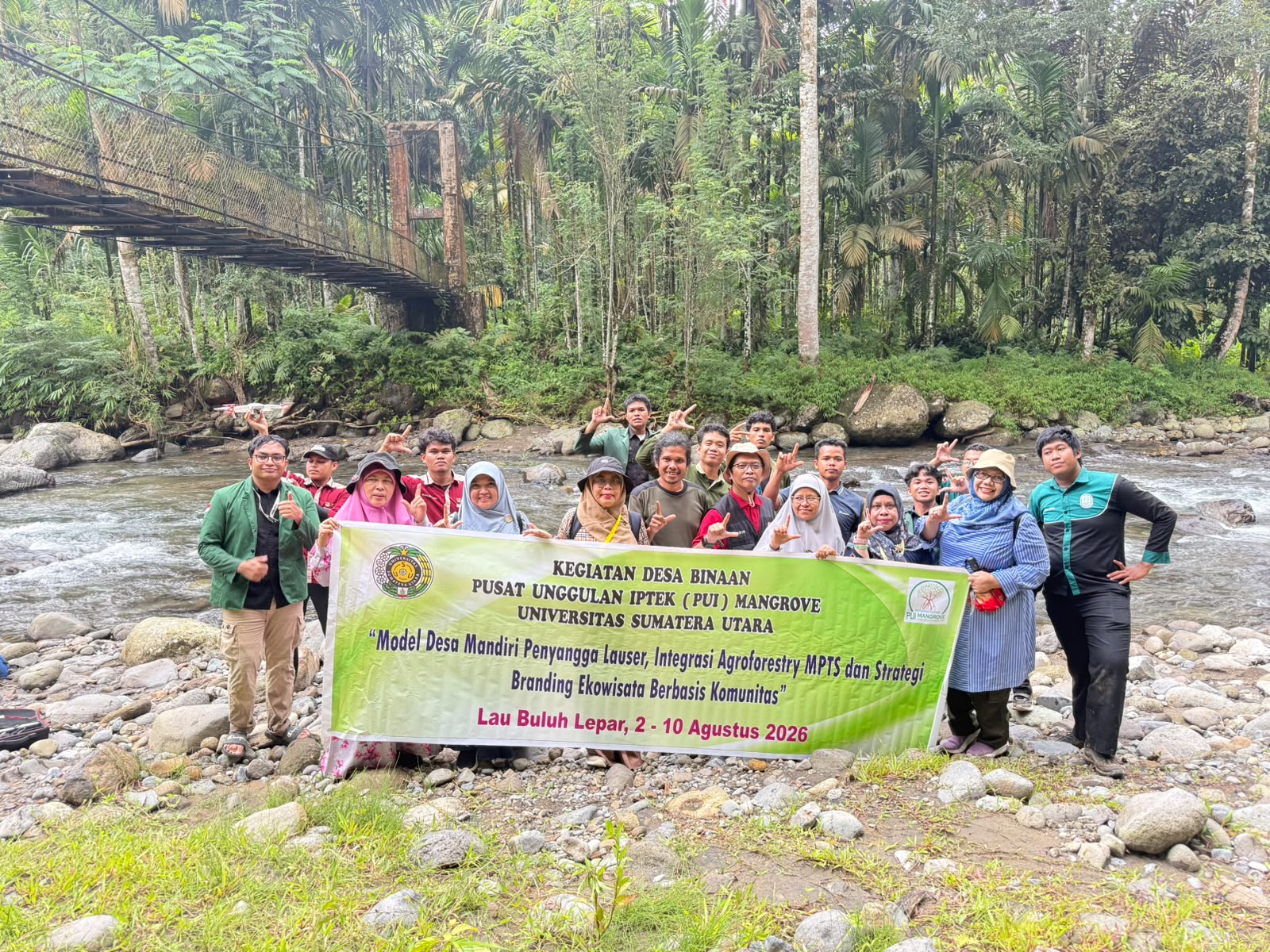
The Community Development Program consists of two complementary initiatives. The first program is titled “Accelerating the Green Economy in Lau Buluh Lepar Hamlet: Community Empowerment through the Utilization of Multi-Purpose Tree Species (MPTS) and the Optimization of Ecosystem Services.” The program is led by Prof. Mohammad Basyuni, S.Hut., M.Si., Ph.D., with Dr. Agr. Faujiah Nurhasanah Ritonga, S.Hut., M.Si. serving as Coordinator 1.
The first program’s implementation team consists of Dr. Deni Elfiati, S.P., M.P.; Dr. Oding Affandi, S.Hut., M.P.; Dr. Iwan Risnasari, S.Hut., M.Si.; Dr. Bejo Slamet, S.Hut., M.Si.; Ir. Netti Herlina, M.T.; and Ipanna Enggar Susetya, S.Kel., M.Si.
Meanwhile, the second program carries the theme “Revitalizing the Leuser Buffer Zone: Developing Ecotourism and Strengthening Food Security in Lau Buluh Lepar through MPTS Planting.” This program is also led by Prof. Mohammad Basyuni, S.Hut., M.Si., Ph.D., with Dr. Erni Jumilawaty, S.Si., M.Si. serving as Coordinator 2.
The second program’s implementation team consists of Prof. Dr. Etti Sartina Siregar, S.Si., M.Si.; Arif Nuryawan, S.Hut., M.Si., Ph.D.; Prof. Dr. Delvian, S.P., M.P.; Dr. Nelly Anna, S.Hut., M.Si.; Dr. Nurdin Sulistiyono, S.Hut., M.Si.; and Ameilia Zuliyanti
As part of the program launch, the USU team and local community carried out several activities integrating ecological, social, and economic aspects. One of these was the establishment of a lubuk larangan, a form of aquatic resource conservation based on the community’s local wisdom.
The activities also included the planting of Multi-Purpose Tree Species (MPTS), which are tree species that provide multiple benefits to communities while supporting the ecological functions of the area. The development of MPTS is expected to strengthen food security, protect the environment, and create opportunities to increase community income through the sustainable utilization of plant products.
In addition to developing agroforestry, USU is also encouraging the utilization of local potential as part of ecotourism development. One example is the introduction of a bamboo slide, which utilizes locally available resources and can be developed as a nature-based tourism attraction through community creativity.
This approach demonstrates that ecotourism development is not solely oriented toward attracting visitors but is also intended to create added value for local communities without compromising environmental sustainability.
The USU Community Development Program also involves students as part of an experiential learning process. Eight students, consisting of four students from the Undergraduate Program in Forestry and four students from the Undergraduate Program in Biology, were directly involved in the village development activities for eight days.
Student involvement provided an opportunity to connect knowledge acquired in the classroom with real-world conditions in the field. Together with the community, the students learned about local potential, needs, and challenges in managing natural resources while contributing to the implementation of the village development program.
Through this approach, the community is positioned as a key actor in the development process. Local knowledge and regional potential serve as important foundations for designing programs that reflect the village’s characteristics and can provide long-term benefits.
The integration of MPTS-based agroforestry, natural resource conservation, ecosystem service optimization, food security, bamboo utilization, and ecotourism development forms the foundation for developing Lau Buluh Lepar as a model of a self-reliant village in the Leuser buffer zone.
Collaboration between USU and the community is also expected to continue expanding through the involvement of local governments and other relevant stakeholders. Such synergy is important to ensure that the program does not stop at its launch but continues through ongoing assistance, community capacity building, and sustainable development of the village’s potential.
This initiative aligns with the Sustainable Development Goals (SDGs), particularly SDG 8: Decent Work and Economic Growth, SDG 11: Sustainable Cities and Communities, SDG 13: Climate Action, SDG 15: Life on Land, and SDG 17: Partnerships for the Goals.
Through an approach that combines scientific knowledge, local wisdom, conservation, and community empowerment, Lau Buluh Lepar is expected to develop into a village capable of preserving its natural wealth while creating economic opportunities for its community.
From the Leuser buffer zone, USU and the local community are advancing a simple yet important idea: protecting nature and improving community welfare are not competing goals but can go hand in hand through collaboration and sustainable resource management.